Beyond "Doing Less Harm": Why the Future of Climate Tech Belongs to Net-Positive Infrastructure
Updated: Aug 20

At this year's Co_Invest Climate 2026 conference in Chicago, hosted by Evergreen Climate Innovations, the conversation around clean technology shifted from passive mitigation to active, rapid scaling.

Keynote speaker Tom Chi (Co-Founder of Google X and Founding Partner at At One Ventures) challenged founders, investors, and civic leaders to reframe how we build solutions for the planet.
Source: Thinkers 50
The core takeaway? Real industrial decarbonization doesn’t happen through regulatory mandates or moral persuasion alone. It happens at the intersection of Deep Tech, Unit Economics, and Environmental Economics. When clean technologies deliver superior business margins, faster deployment timelines, and better reliability, market adoption accelerates organically.
Here is how those insights are reshaping clean transit and energy infrastructure, and how we put those principles into practice at Skyhook Solar.
3 Core Takeaways from Co_Invest Climate 2026
1. Shift Utilization to Preserve Resources
Tom Chi pointed to autonomous mobility as a prime example of asset efficiency: elevating vehicle utilization from a dismal 4% (as opposed to the time a car is spent parked) fundamentally alters how many physical assets are required to support a city.

In micromobility and electric vehicle (EV) charging, asset utilization is equally vital. Charging hubs must maximize operational uptime and port availability. Tying up capital in multi-year utility interconnect queues leaves critical chargers idle when fleets and riders need them most.
2. Target High-Impact Industrial Systems
A small percentage of industrial sectors generate the vast majority of environmental strain. Solving climate challenges doesn't require reinventing every consumer process simultaneously; it requires surgical, targeted innovation where the impact is highest. In transit, targeting the energization bottleneck—the friction between site selection and grid activation—delivers exponential returns for clean transit adoption.
3. Build with Integrity for the Long Haul
In an attention economy driven by short-term fixes, engineering durability provides much-needed stability. Systems designed thoughtfully from the start solve structural infrastructure challenges for decades, rather than applying temporary patches that require premature replacement.
Putting Theory into Practice: How Skyhook Solar Aligns Unit Economics with Sustainability
Transitioning fleets or micromobility networks to electric power shouldn't require 12-to-18-month utility study queues, costly transformer upgrades, or tearing up city sidewalks for heavy electrical conduit.

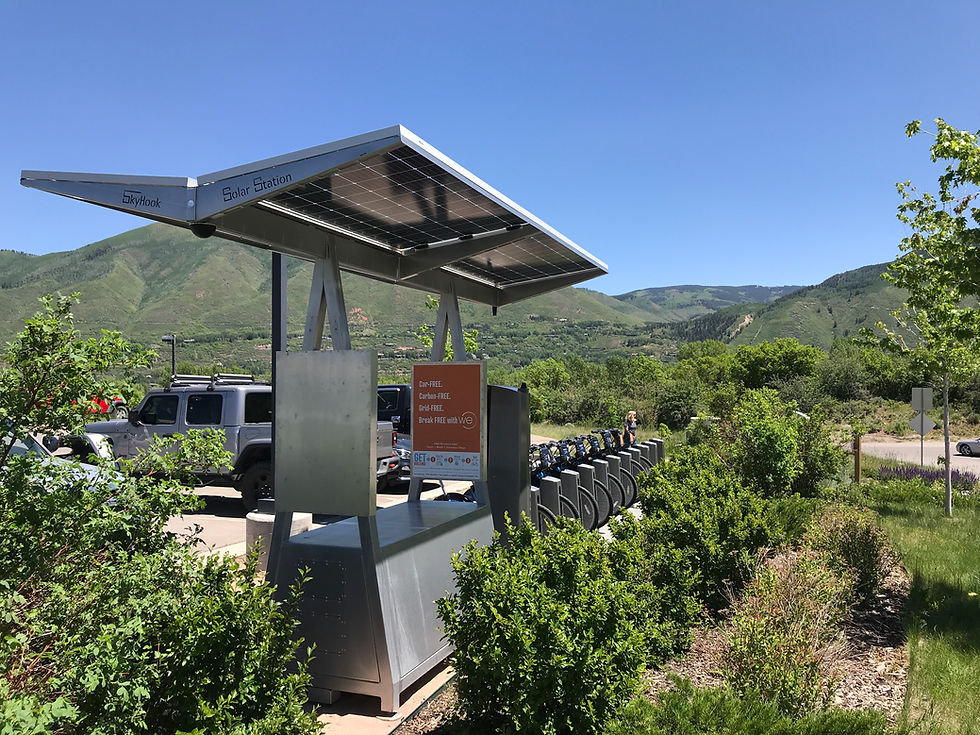
At Skyhook Solar, we engineered our Solar Stations to address the economic and operational realities of site deployment directly:
Instant Speed-to-Market: Self-contained Solar Stations set up in less than an hour on non-invasive, weighted bases. By qualifying as temporary equipment, hosts bypass invasive ground trenching and years of utility interconnection friction.
Thermal Safety & Battery Durability: Built using Lithium Iron Phosphate (LiFePO4) battery chemistry, our storage systems provide higher thermal stability than standard lithium-ion options—maintaining reliable power thresholds through severe sub-zero winters and extreme summer heat cycles.
Bifacial Solar Harvesting: High-efficiency overhead canopies capture direct sunlight while simultaneously harvesting ambient reflected light (albedo) from surrounding asphalt or snow cover to maximize power yield.
We can’t solve every global infrastructure hurdle overnight. But by pairing practical unit economics with robust clean technology, we can do what we can to build durable, net-positive infrastructure that accelerates the clean energy transition today.
Join the Conversation
How is your organization navigating utility bottlenecks and site deployment timelines this year?

Comments