top of page


10,000lb, 1,569 Miles, 100% Electric


Grand Junction to Santa Barbara Earth Day

We are so happy to have been a part of such an awesome event: Earth Day Santa Barbara. Honestly, what better event for Skyhook to attend than one so closely aligned with our values?

We wanted to test what the future actually feels like and walk the walk.

So instead of towing our Solar Stations to Earth Day Santa Barbara with a traditional diesel truck, we leased a Chevy Silverado EV and drove the entire 1,569 mile route on electrons.


And because towing nearly 10,000 pounds this far in an EV still feels relatively unexplored territory—and because we knew our community would be just as curious as we were—we documented the experience along the way to share what worked, what surprised us, and what the future of road tripping with heavy loads might actually look like.


The Why: Climate Change Along the Way

Earth Day is a reminder of the responsibility we all share to care for the planet and reflect on how our actions affect the world around us.


Skyhook was started with a simple philosophy: do what you can.


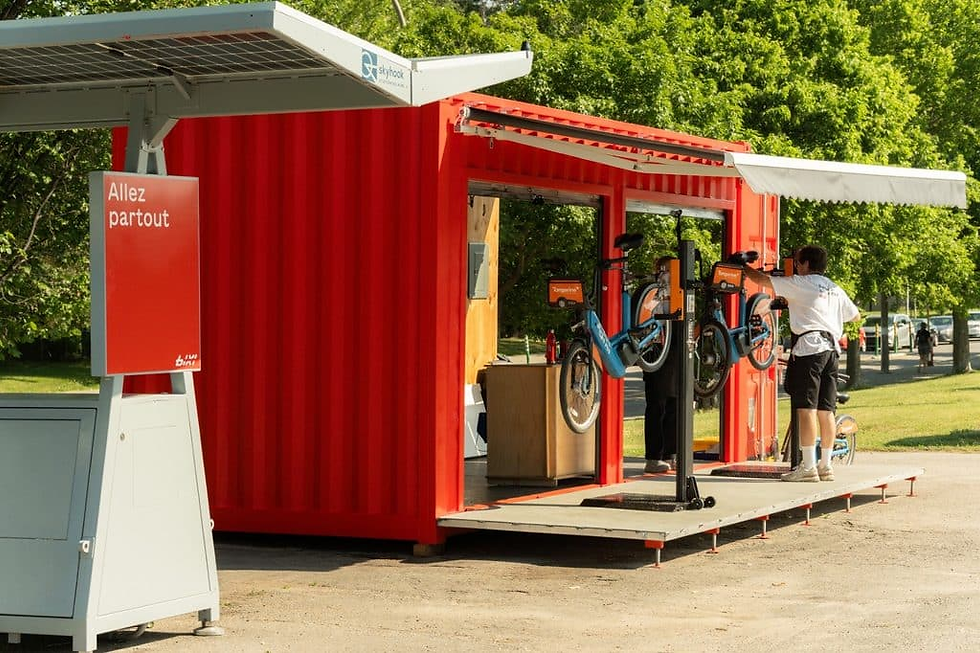
Our Solar Stations were designed to support the transition to cleaner energy in the EV and micro-mobility industries by making charging more flexible, deployable, and accessible.


We left our home base in Grand Junction after experiencing one of the shortest winters Colorado has seen in years. Snowfall totals were alarmingly low. Ski resorts experienced spring-like conditions as early as February, and many seasons ended months earlier than normal. That lack of snowpack is now contributing to drought conditions across the region, with the Colorado River experiencing dangerously low levels after a difficult winter.


And we saw reminders of climate change everywhere along our route.


Driving through Baker, California, we stopped at the World’s Largest Thermometer—a monument to the hottest temperature ever recorded on Earth nearby in Death Valley: 134°F. Temperatures like these are becoming more frequent, and extreme heat events continue to intensify across the Southwest.

Then in Wrightwood, California, we passed through the visible burn scars left behind by the 2024 Bridge Fire, where over 56,000 acres burned during a fire that lasted 79 days, destroying homes and reshaping entire landscapes.


From drought in Colorado to extreme heat in the desert to wildfire damage in California, we experienced the effects of climate change across the entire journey.


Instead of leaving us discouraged, those moments reminded us of why we do what we can.

And sometimes that starts with towing Solar Stations across the desert using an EV.


The Charging Experience

Charging infrastructure was far more available than we expected. Along the route, we had the opportunity to use a wide range of fast charging networks including Tesla, Electrify America, IONNA, Rivian, and EVgo.


Even more surprising: many charging locations had designated pull-through trailer charging spots. Roughly three-quarters of our charging stops allowed us to simply pull in, plug in, and continue on our way without ever dropping the trailer. That became a huge time saver considering we were making anywhere from three to six charging stops per driving day.


The trip also highlighted something important about EV ownership: driving electric requires a shift in mindset.


You have to plan more. Charging takes longer than filling a gas tank. And road trips become less about sprinting from destination to destination and more about pacing yourself around charging opportunities.

But interestingly, the slower pace wasn’t always a bad thing. Some charging stops became welcome breaks—an excuse to stretch our legs, grab lunch together, answer emails, or take in places we normally would have rushed past. In Las Vegas, one charge stop even turned into a quick casino break while the truck powered back up. Charging changed the rhythm of the trip. Instead of nonstop driving, the journey felt more intentional and surprisingly more enjoyable at times.


But should EV drivers have to sacrifice comfort and convenience completely?


Some charging locations actually felt like the future—covered canopies for shade, clean layouts, trash bins, windshield washing stations, nearby coffee, and room to stretch while charging.

Others reminded us there is still a long way to go.


Range anxiety itself wasn’t the biggest challenge. The infrastructure generally worked. What we found ourselves wanting more often was a better overall experience: more amenities and more thoughtful design around how people actually use these spaces while traveling.


Lessons Learned 

No road trip is complete without at least one moment of range anxiety. Ours happened in rural Utah.

We arrived at a charger location expecting to plug into a Level 2 Tesla charger for the night. We had brought a Tesla fast-charging adapter—which physically fits both Level 2 and Superchargers—but learned the hard way that you actually need two separate adapters depending on the charger type.

That left us temporarily stranded without access to charging in a pretty remote area.


Luckily… we happened to be towing a solar powered EV charger behind us! We plugged directly into our own D6 Skyhook Solar Station overnight, which added about 13kWh of energy to the truck’s battery according to our Skyhook Level X charge app. While we technically had enough range to make it back to the nearest fast charger regardless, the extra charge gave us a helpful buffer and eased our range anxiety in such a remote area. It boosted our expected arrival state of charge (SOC) from roughly 35% to 41%.


This moment perfectly captured both where EV infrastructure is today and where it still needs improvement. Most of the journey went surprisingly smoothly, but small compatibility issues like adapters, apps, and charger types can still create friction—especially in rural areas.


It also reminded us why flexibility and resiliency matter so much in energy infrastructure.


While there’s still room for improvement in charging infrastructure and charging experience design, the technology itself is becoming surprisingly capable.


For us, this trip wasn’t just about getting Solar Stations to an event.

It was about testing the future ourselves.


And after 1,569 miles, thousands of pounds, countless charging stops, and a lot of curiosity from people along the way… we came back optimistic.


The transition to cleaner transportation won’t happen perfectly.

But it is happening. 


Problem Statement

Traditional EV charging infrastructure often faces significant hurdles that prevent rapid adoption. For many sites, installing a standard grid-tied charger requires extensive trenching, electrical upgrades, and permitting, leading to high construction costs and lengthy project timelines (often months or years). Additionally, many locations lack the available grid capacity to support new Level 2 chargers without expensive transformer upgrades. At the Aspen Community School (ACS) site, there was a specific need to upgrade an aging Level 1 solar unit to a more powerful Level 2 system without the disruption of traditional site construction or the environmental impact of grid-heavy expansion.


Project Overview

Skyhook Solar partnered with SWTCH Energy and LG Electronics to develop this fully off-grid EV charging station. Building on their expertise in innovating solar charging stations since 2020, this particular unit, the D6 Solar Station, took a couple of months to manufacture and less than one hour to deploy. This highlights a significant reduction in construction time and costs compared to traditional, grid-tied installations.

The D6 was deployed at ACS to replace a smaller Level 1 EV charging Solar Station that had been used for workplace charging there since the spring of 2020. By transitioning to this immediate, turnkey solution, the customer bypassed the lengthy, disruptive site construction typically required for grid-capacity upgrades

Partner Background: SWTCH

Founded in 2016, SWTCH Energy is a North American leader in EV charging and energy management solutions, specifically known for its focus on multi-tenant, commercial, and workplace environments. Their technology is built on the Open Charge Point Protocol (OCPP), ensuring high interoperability and scalability. For this project, SWTCH provides the critical software infrastructure and energy management platform that allows for remote monitoring and optimized power distribution, which is vital for managing the variable energy output of a solar-dependent system.


About Skyhook Solar

Based in Grand Junction, CO, Skyhook Solar is engineering solutions for powering equitable broadband, micromobility, and EV charging with clean energy. Skyhook Solar Stations require no on-site construction or electrical permitting and can be delivered and up and running immediately, bringing power when and where it’s needed.

To date, Skyhook has successfully deployed Solar Stations in four countries and multiple cities, including Montreal, Toronto, Detroit, Chicago, and Washington, DC. For more information, please visit www.skyhooksolar.com or follow us on LinkedIn.


Technical Specifications

The station is a fully off-grid unit designed for maximum resilience and a minimal carbon footprint.

  • Solar & Storage Component: The system features a 3.24kW bifacial PV array paired with a 19.2kWh LiFePO4 battery storage system.

  • Charging Infrastructure: The station provides two Level 2 charging ports using the standard Type 1 (SAE J1772) connector, delivering a combined output power level of 3.6kW.

  • Versatility: While this unit is solar-only, Skyhook also offers grid-supplemented variants that can "piggyback" off 120VAC or 120/240VAC circuits that may already be onsite.


Strategic Lessons

This project delivers an immediate, turnkey charging solution that bypasses lengthy, disruptive site construction. A key lesson learned from the installation is the necessity of managing customer expectations regarding capacity. Unlike 100% duty-cycle grid chargers, the energy output of a solar-only system is dependent on environmental factors, such as cloud cover and storms. It is an ideal, resilient solution for locations seeking to minimize their carbon footprint while relying on renewable energy.


bottom of page