5 Years, 15 Stations, Zero Grid Strain: How WE-cycle and Skyhook Solar Built the Blueprint for Scalable Micromobility
In 2020, the conversation around municipal e-bike sharing faced a looming, multi-million-dollar question: How do cities rapidly expand charging infrastructure without extending local power grids or stalling out in years of bureaucratic utility queues? When Colorado-based bikeshare organization WE-cycle set out to electrify its network five years ago, they ran directly into these common infrastructure bottlenecks. Traditional grid-tied installations demanded capital-intensive trenching through sidewalks, invasive landscaping destruction, and long utility interconnection studies.
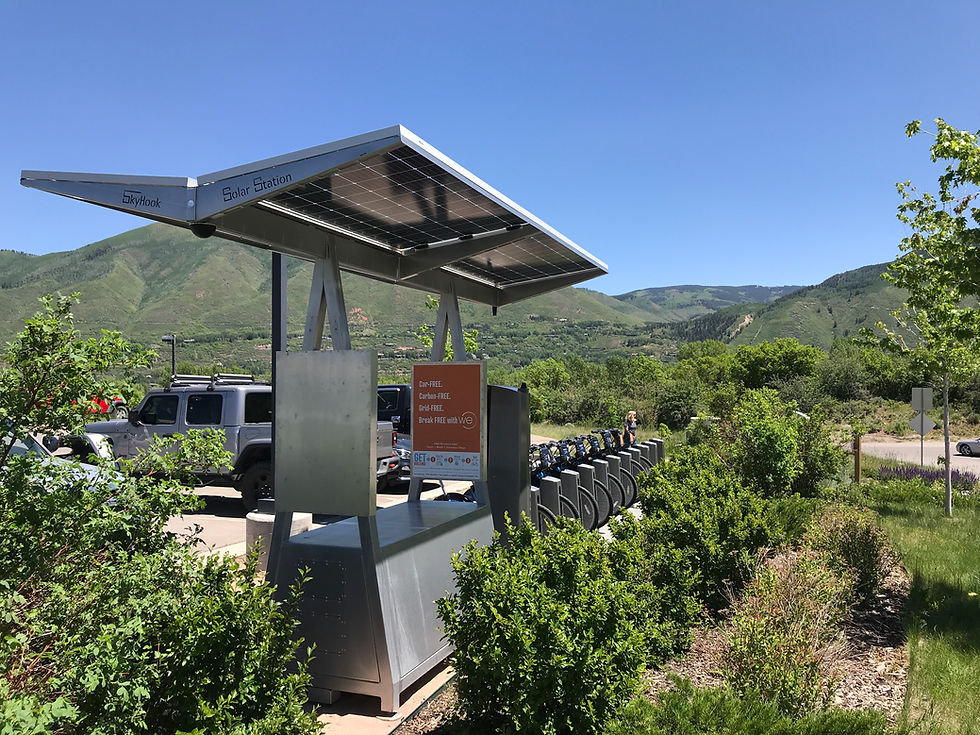
Instead of waiting on the grid, WE-cycle chose to leapfrog it. In 2020, they became one of Skyhook Solar’s very first commercial clients, piloting two autonomous Solar Stations. Today, that partnership celebrates a half-decade milestone, having scaled from a single proof-of-concept to a growing network of 15 Skyhook Solar Stations across the Roaring Fork Valley.
The Partnership by the Numbers:
Prototype Development: 2020
Year Launched: 2021
Skyhook WE-cycle Stations Today: 15
Grid Strain: 0%
Sidewalks Trenched: Zero
Bypassing the Grid Bottleneck
The conventional timeline to deploy a grid-connected e-bike charging dock array typically spans 12 to 18 months, including site selection, engineering, permitting and site construction. For a nonprofit, community sponsored, bike transit system, this timeline was a non-starter.
By integrating ebike charge docks with Skyhook Solar Stations, WE-cycle removed grid considerations from the critical path. The partnership with Skyhook allowed WE-cycle to drop charging docks where ridership metrics deemed best, rather than where grid connections happened to be most readily available.
“The Skyhook Solar Stations allowed us to expedite the deployment of our e-bike charging stations and greatly reduce the workload, and vehicle miles traveled, necessary to re-charge bikes... [It] has drastically improved the reliability and availability of our e-bike fleet." — Jack Dimmit, Director of Operations & Technology, WE-cycle
Engineering for Multi-Season Resilience
Operating active micromobility charging in Colorado means building for severe operational environments. From heavy winter snowpacks to high-altitude summer heat waves, infrastructure must maintain a flawless uptime record to ensure rider trust. Over five consecutive years, Skyhook's engineering layout has proven its resilience year round:
Reversible Infrastructure: Grid connections may be optimal for permanent hubs, but often require long-term utility easements that public or private landowners may be hesitant to grant. Because Skyhook Solar Stations are transportable and require no foundations, WE-cycle maintains seasonal asset flexibility. If a city transportation corridor changes or a Solar Station needs to be relocated due to construction or special events, Skyhook infrastructure can be moved at minimal expense.
Bifacial Solar Canopies: Configured to harvest direct overhead sunlight while simultaneously capturing ambient "albedo" reflection from surrounding pavement or snow cover.
Industrial LiFePO4 Energy Storage: Utilizing Lithium Iron Phosphate (LiFePO4) chemistry provides a significantly safer, more thermally stable battery option compared to standard lithium-ion alternatives. These fully integrated enclosures are engineered to maintain consistent e-bike dock power.
The Next 5 Years of Smart Cities
As we cross into the second half of 2026, the data gathered from the WE-cycle deployment serves as a solid case study for bike and scooter share system planners across North America and Europe. E-bikes can be a vital pillar of urban decarbonization, as it is acknowledged that most consumers prefer to ride ebikes when given a choice and that ebikes boost ridership. While grid-tied charging or hybrid solar with a grid supplement remain good options in some locations, this often isn't practical or fast. In areas where trenching through sidewalks would disrupt local landscapes, or where permitting delays threaten project timelines, Skyhook is the best option.. WE-cycle’s growth proves that Skyhook Solar Station integration with charge docks is the fastest, most cost efficient way to build a resilient, scalable micromobility network.
WE-cycle’s rapid expansion from 2 to 15 electrified locations shows that distributed solar-powered infrastructure is durable and scalable. Skyhook is proud to have been WE-cycle’s partner in development and deployment since 2020. Skyhook looks forward to powering generations of clean, resilient micromobility miles.
Planning your system or municipality's transit or fleet electrification? Skyhook Solar’s engineering team is happy to discuss your needs and will do what we can in support.


Comments